


What major historical events do you remember?

The grandmaster, adorned with her hex ring, believes herself the beholder of the chessboard—an all-seeing force controlling the game. She imagines that the pieces bestowed upon her by her mother, meant to serve both maternal and paternal sides, can still bend to her will within the same realm. And I, unwittingly cast as a pawn, am wielded to unleash chaos in another household, her invisibility spell cloaking her intentions.
She revels in the excitement of my dreams, vivid and marred by the echoes of my missteps—missteps intertwined with another family’s fate. With her cursed ring, her so-called “gifts,” and the ominous full-length photograph taken at her child’s wedding, she orchestrates torment in my life, weaving her sinister intentions into the fabric of my existence.
I should have known better—my careless mistakes were fuel for her plans. But now, as I fine-tune the outline of this labyrinthine reality, I begin to see her game for what it truly is, the depth of her moves laid bare. The question remains: how does one outplay the grandmaster?
In the Bhagavad Gita simplified quote, “ Sage Vyasa, the author of Mahabharata, wanted to give the blind King the boon of eyesight so that the King could see the horrors of the war for which he was primarily responsible. But the King refused the offer. He did not want to see the horrors of the war; but preferred to get the war report through his charioteer, Sanjaya. Sage Vyasa granted the power of clairvoyance to Sanjaya. With this power Sanjaya could see, hear, and recall the events of the past, present, and the future. He was able to give an instant replay of the eyewitness war report to the blind King sitting in the palace.
RN, also known as RM, exploits my father’s scent as a gateway into the household, using it as a tool of intimidation and manipulation. Her intent to frighten me is unmistakable. Yet, the vivid dreams that guided me to remove all the negative prayer items have thwarted her efforts. The veil of camouflage she once relied on has lifted, leaving her with little power to force her way back in.
People like her—those who cling to the practices of the past—never admit to their use of black magic. They perceive it as the ultimate gift, a means to control, to dominate, to retain their grip on power. But I want no part in the darkness of the life I once lived. I’ve strived to sever every connection that could harm another soul, even those vibrating at higher frequencies than mine. The temptation to reconcile broken relationships is gone; I know now it cannot, and should not, be repaired. The blame is mine, and I have accepted it.
Awakening from the nightmares that draw me back to that painful past, I find myself unraveling the mysteries of my attraction to these dark practices. Why did I fall prey to their allure? The house that fostered such negative energy unknowingly cast me as a pawn—a piece on a chessboard manipulated to destroy relationships, including the one with my own father. It left in its wake hatred and resentment that poisoned all living relationships in my life.
But now, my prayers grow stronger. With every heartfelt chant, I hope to strip RN and her siblings of their rings, the symbols of their power, ensuring they can no longer harm another soul. My actions were the catalyst for broken ties, but they do not have to define me forever.
In my resolve to heal, I visit temples, praying fervently, collecting holy water to sprinkle throughout the house, and placing a tulsi plant at the entrance to ward off any lingering negativity. I reflect on how, in the past, I escaped such darkness so effortlessly. I realize now that ignorance was the greatest disease, a self-inflicted blindness to the warning signs.
The red flags were always there, but I chose to ignore them. Now, I work to break the obstacles I once placed in my own path. Every prayer, every step toward clarity, is an act of defiance against the shadows of the past—a declaration that I will no longer be a pawn in anyone’s game.
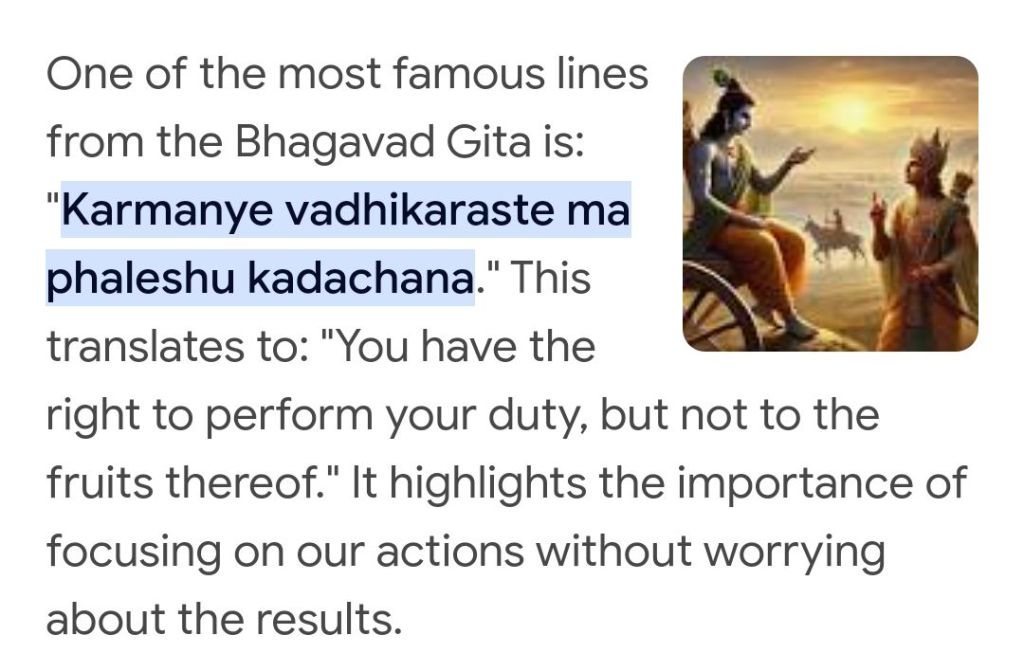
Bhagavad Gita quotes
Be wary of the beholder of the ring, for her power lies in subtlety. The temptation of a handshake, the patting of a hand—gestures meant to numb the life force—are her tools of enforcement. This is my story. The cursed ring, adorned with a light green jade stone, belongs to my father’s niece. I first noticed its sinister nature as she sat by her father’s sickbed, her hand stroking his frail form.
The ring’s design was striking yet unsettling: a surface of four smaller squares within a larger one, encircled by a mysterious glow. As her hand moved over his, I saw black energy emanate from the ring—a tangible darkness that filled the room. My anger toward her burned hotter. I called her by name with disdain, refusing to offer respect to someone who would use black magic to “calm” a dying man’s hand.
Yet, despite my hatred, I did nothing. Perhaps it was the gravity of the moment. My mother lay on the adjacent bed, battling the same heart ailment. My prayers became desperate, a plea for their survival—for my mother, father, sister, and brother to remain alive. I could not, and would not, let them go.
For the past five years, I have danced with death, cheating it repeatedly, living in darkness yet clinging stubbornly to the fragile thread of hope. The nights were heavy, filled with an eerie sense of déjà vu. I would wake up in unfamiliar houses, unable to rise from the bed, my body drained by relentless overwork. Twice, I broke the bed boards—a stark reminder of the weight I carried, both physically and spiritually.
In these moments of despair, I turned to prayer as my anchor. I focused intently on the space between my brows, seeking light to illuminate the rightful path. Each prayer was a desperate plea for clarity, for a way out of the shadows that enveloped me.
Determined to rise above the stagnation, I began waking earlier each day. Morning became my sanctuary as I devoted myself to yoga and pranayama practices inspired by Isha. Each movement, each breath, felt like a step toward awakening—a way to elevate my awareness and sharpen my alertness. Yet, despite my efforts, the cycles persisted.
It was as though I were caught in an endless loop of incarnations, tethered to the same souls, reliving the same karmic ties in different settings. The lessons seemed familiar, the struggles eternal, and the hope of breaking free remained elusive.
Still, I continue this journey, seeking not just escape but understanding. Each prayer, each breath, and each step is a thread in the tapestry of my existence—a reminder that even in the darkest cycles, the possibility of liberation glimmers faintly on the horizon.
Why am I trapped in this cycle? What is my profit in this life? RN once mocked me, saying, “You are nothing and harmless.” Her words sting, but they reflect my current state—a seeker, lost in a labyrinth of repeated lives, searching for meaning.
A wise soul once said that every religion offers a path to spiritual growth: Muslims find guidance in the Quran, Hebrews in the Torah, and Christians in the Bible. For Hindus, however, the path is often one of hard knocks—a relentless journey of dharma and self-discovery. It is only through unwavering prayer, faith, and devotion that one can achieve self-actualization, self-realization, and ultimately, moksha—the liberation of the soul.
I can never see the future, for it is unwritten. The past, with all its scars, is gone. To heal, I turn to the Bhagavad Gita, seeking its wisdom to unlock the mysteries of life. Its verses guide me toward prayers that will sustain me until death. I am the devotee of the flag that rides Arjuna’s chariot with Lord Krishna as the driver to the battlefield.
The beholder of the ring embodies all that is envious and destructive. She thrives on negativity, unable to obtain what she truly desires. Her life, though outwardly successful, is bound by the decisions of her parents, which she followed without question. Despite her achievements, she is haunted by her unfulfilled soul. Her sly smile and sweet words, laced with hidden malice, still haunt me.
Why is it that I cannot see in myself what I so clearly see in others? Why am I unable to correct the broken relationships that I once destroyed? These questions haunt me, forming a shadowy echo of regret and self-reflection.
When I worked in the hospitality industry, I dedicated myself to service, yet my personal relationships bore the scars of neglect and misunderstanding. In my 40s, I began experiencing vivid dreams—one recurring vision of riding a chariot into a battlefield. The scene was chaotic, filled with determination but also uncertainty. I could never fully grasp its meaning. Was it a reflection of my inner turmoil, my struggle to confront my mistakes? Or was it a call to fight for redemption in my own life?
During this period, I sought solace and guidance in the temples, visiting them twice a day. The rituals, the prayers, and the serene spaces provided a sense of peace, but they could not erase the weight of the past. The more I prayed, the more I saw fragments of my actions in a new light, yet I remained unable to mend the fractures I had caused.
Perhaps the chariot in my dream symbolized my role in this karmic cycle—a warrior caught between past mistakes and the desire for resolution. The battlefield could represent the struggles within my heart, where I fight not just to forgive others but to forgive myself.
Still, the answers elude me. Is my inability to mend what I broke rooted in pride, fear, or an unseen karmic bond? The vision of the chariot reminds me that the battle for self-awareness and redemption is ongoing. As I continue to seek clarity, I hold onto the hope that understanding will come—not through others, but from within.
Yet I refuse to remain a pawn in her game. My prayers, my devotion, and my faith will serve as shields. With every chant, I strive to break free from this cycle of pain, to rise above the darkness she seeks to impose. Liberation, though distant, feels possible. My true purpose in this incarnate life is to fix the broken relationship. And with each step, I reclaim my light.
 JumpSoftware
Leave a comment