


Who are you most inspired by?
The wise grieve neither for the living nor the dead.” — Bhagavad Gita
There was once a seeker who asked his teacher, “Who inspires you the most?”The teacher smiled and pointed not to a king, a warrior, or a saint, but to the dawn itself.
“Every morning,” he said, “the sun rises without carrying yesterday’s darkness. The river flows without clinging to the stones it has touched. Nature knows how to reset.”
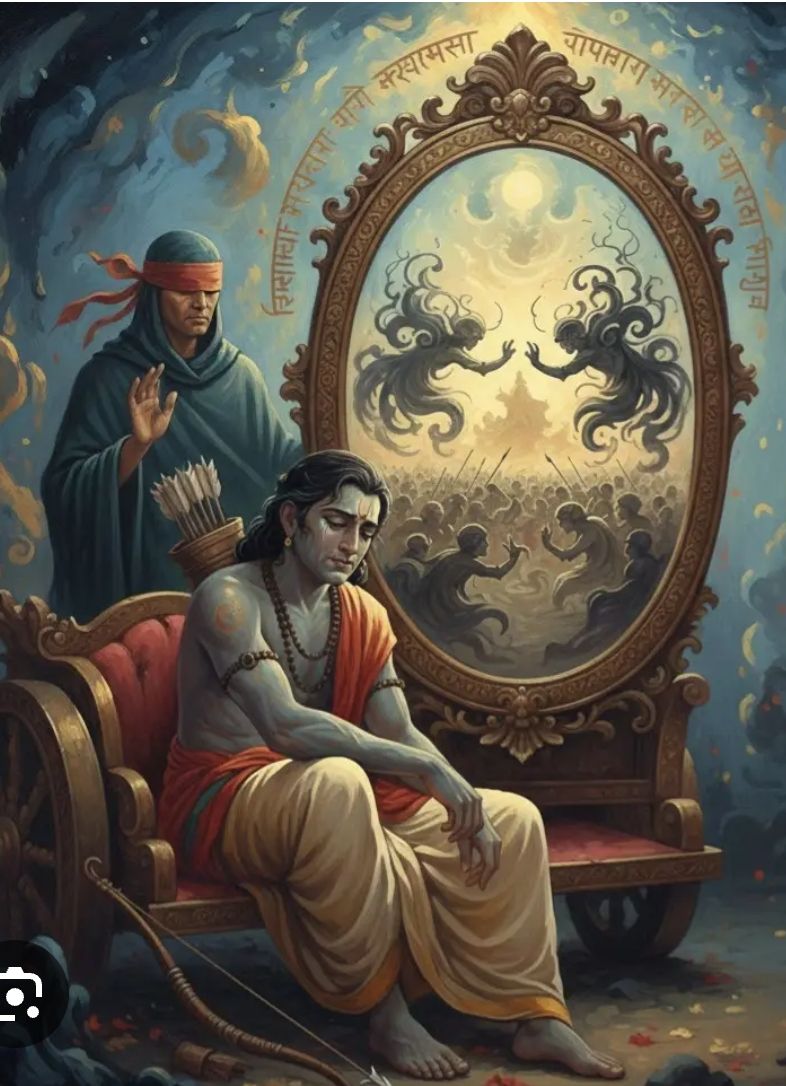
The seeker asked, “Then who among humans teaches us this art?”The teacher replied, “Arjuna.”For Arjuna was not born fearless. On the battlefield, his mind became a storm of grief, confusion, guilt, hesitation, and doubt. He wished to turn away. Yet he did not hide his confusion. He admitted it. He listened. He questioned. He learned.The seeker walked on this teaching for many days.
One day, another traveller approached and asked the seeker a question.
The words came quickly, wrapped like a parcel tied with many knots. The seeker did not understand what was inside. Yet, fearing conflict, fearing ridicule, fearing being called difficult, the seeker nodded and said, “Yes.”
The traveller left.
Only later did the seeker discover that the parcel contained manipulation, instigation, poking, accusations, and meanings the seeker had never intended to accept.
The seeker cried, “Teacher, why did this happen? I only agreed to the words. I did not know what was hidden within them.”
The teacher picked up an unopened parcel and placed it before the seeker.
“If a stranger hands you a parcel,” the teacher asked, “would you sign for it without reading the label?”
“No,” replied the seeker.
“Then why does the mind sign for every spoken parcel it receives? Why accept blame you do not understand? Why agree to meanings you have not examined?”
The seeker lowered their head.”But the damage has been done,” the seeker whispered. “There is no point crying wolf after the village has burned.”
The teacher nodded.”It is true.
Once an arrow leaves the bow, it cannot be called back. Some consequences must be faced. Tears cannot rewrite yesterday.””But,” the teacher continued, “wisdom is not learning how never to make mistakes. Wisdom is learning not to repeat them unconsciously.”
“The first lesson is not to sign blindly.”
“The second is to ask, ‘What do you mean?’”
“The third is to say, ‘I do not understand. Explain it to me again.’”
“And the fourth is to accept responsibility for your own part without carrying burdens that were never yours.”
The seeker remained silent.The teacher then said, “Manipulation often thrives in haste.
Awareness moves slowly enough to see clearly. There is no shame in saying, ‘I need time before I answer.’
“The seeker understood that resetting the mind did not mean pretending no damage had been done. It meant refusing to let yesterday’s unconscious acceptance become tomorrow’s habit.
Like Arjuna, who admitted, ‘I do not know what is right for me,’ the seeker learned that confusion honestly acknowledged is closer to wisdom than certainty blindly accepted.
From that day onward, when words arrived wrapped in urgency, fear, or hidden meanings, the seeker paused before signing for the parcel.
For no point crying wolf after the damage has been done.But there is every point in awakening before the next parcel arrives.”
From wherever the restless and unsteady mind wanders away, let one gently bring it back under the control of the Self.” — Bhagavad Gita
The Gita reminds the seeker that mistakes are teachers. The mind may wander into blind agreement, fear, or confusion. The practice is to notice, learn, and return to clarity.
Resetting the mind is not erasing the past; it is bringing awareness to the next choice.


You must be logged in to post a comment.