


If you could rewrite any book’s ending, which one would you choose?
If I could rewrite the ending of one book, it would be the ending of Romeo and Juliet. Instead of both lovers dying because of misunderstanding, I would have them awaken to the futility of hatred.
Their love would become the force that reconciles the Montagues and Capulets—not through tragedy, but through wisdom. That ending would remind us that true victory is not in dying for love, but in transforming hatred into understanding.
That lesson echoes the wisdom of the Bhagavad Gita, where the greatest battle is not fought on the battlefield, but within the human mind.
“You have the right to perform your prescribed duty, but you are not entitled to the fruits of your actions. Never consider yourself the cause of the results, and never be attached to inaction.”— Bhagavad Gita 2:47
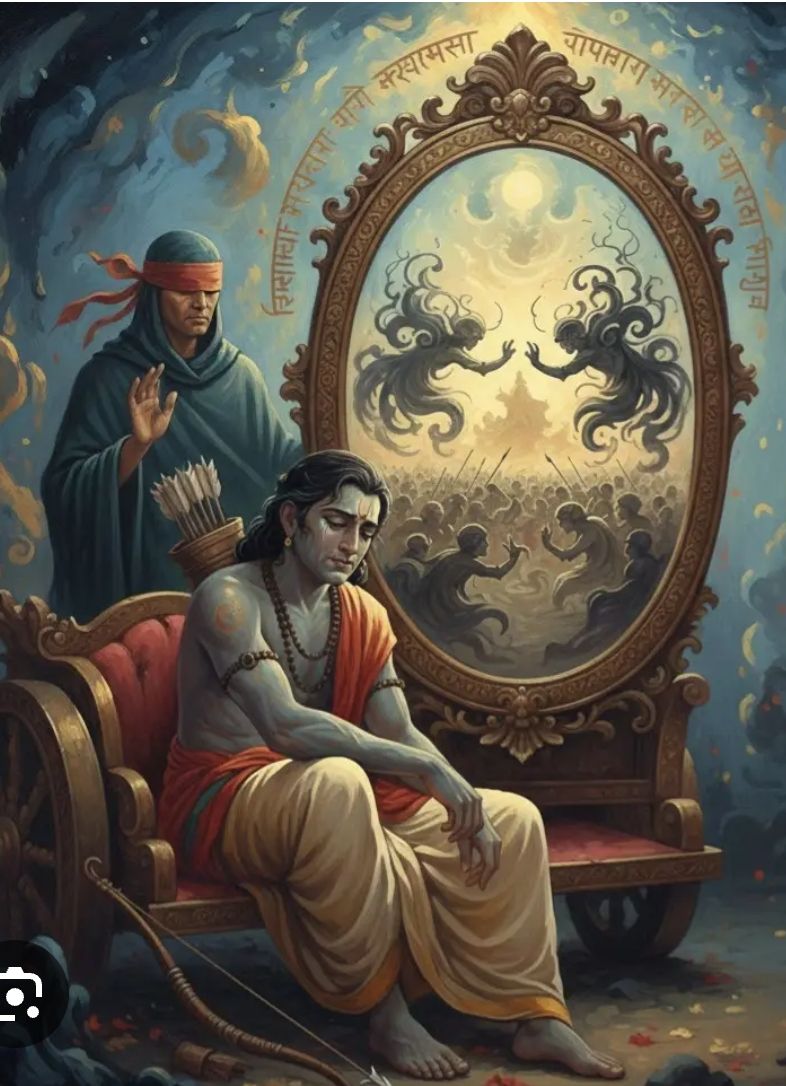
The Gita begins by showing a warrior whose mind is overwhelmed by fear, attachment, grief, and confusion.
Through Krishna’s guidance, Arjuna learns that clarity arises when one acts with awareness rather than emotion.
It concludes with Arjuna’s awakening:
“My delusion is destroyed. By Your grace, I have regained my memory. I stand firm, free from doubt, and I shall act according to Your word.”— Bhagavad Gita 18:73
And the final verse leaves us with an enduring truth:
“Wherever there is Krishna, the Lord of Yoga, and Arjuna, the devoted archer, there will surely be prosperity, victory, well-being, and righteousness.”— Bhagavad Gita 18:78
The journey from confusion to clarity, from the restless chatter of the mind to unwavering awareness, is perhaps the greatest ending any story can have.


You must be logged in to post a comment.